


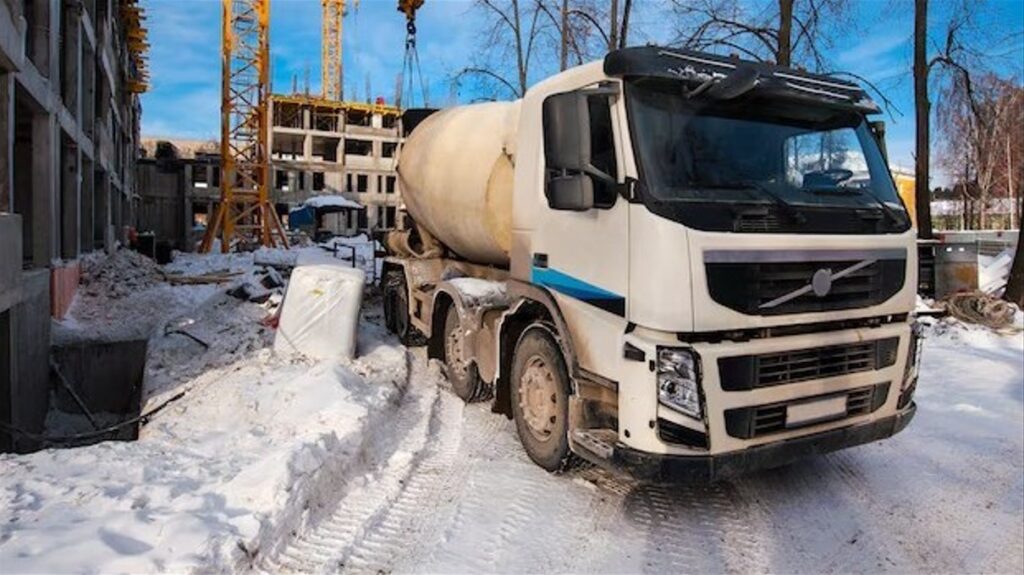
The use of concrete in winter weather conditions requires a specific technical approach to avoid harmful phenomena such as freezing of the mixing water, delay in setting and failure to develop the initial mechanical resistance. These effects, if not properly managed, can compromise the structural integrity of the work and the durability of the concrete over time.
1. Cold-related risks
During the winter season (T < 5°C), phenomena occur that negatively impact the maturation of the concrete:
| PHENOMENON | CONSEQUENCE |
| Water freezing | Volume increase → internal micro-cracks |
| Slowing down cement hydration | Delay in setting and developing resistors |
| Thermal Shock | Temperature differences → thermal shrinkage cracks |
The critical limit not to be exceeded is 0°C: below this threshold, the free water in the dough can freeze, causing irreversible damage to the microstructure.
2. Winter Jet Requirements
2.1 Temperature of fresh concrete
- It must be ≥ +5°C at the time of casting.
- Standards (e.g. UNI EN 206) recommend a minimum temperature to ensure the activation of hydration reactions.
2.2 Ambient Temperature
- If a room temperature < of 0°C is expected within 48 hours of casting, specific protective measures must be taken.
3. Operational strategies for low-temperature casting
3.1 Composition of the mixture
- High reactivity cement: prefer CEM I or CEM II/A type cements.
- Reduced water/cement ratio (w/c): ≤ 0.50, to limit free water.
- Increased cement dosage: improves hydration heat.
- Accelerating or antifreeze additives:
- Based on nitrates, nitrites, formates.
- They promote faster setting and reduce the risk of premature frostbite.
3.2 Preheated Materials
- Mixing water: up to 60°C.
- Aggregates: to be kept dry and, if possible, preheated (>10°C).
- The final temperature of the dough must be controlled in the power plant or on the construction site.
4. Jet protection
4.1 Insulation systems
- Thermal sheets, insulating blankets, polystyrene panels.
- Insulated formwork or formwork made of materials with low thermal conductivity.
- Avoid direct contact of concrete with icy surfaces.
4.2 Heating systems (in critical cases)
- Forced heating of the construction site or casting.
- Use of covered and heated tunnels for particularly exposed structural elements.
5. Care and seasoning
5.1 Critical Phases
- The first 48-72 hours are crucial for the initial development of endurance.
- You need to keep the concrete at a temperature ≥ 5°C during this time.
5.2 Disarming
- Formwork stripping can only take place after verifying that the concrete has reached the specified minimum strength (e.g. Rck ≥ 5 MPa), by means of specimens or maturity calculations.
6. Controls and documentation
- Measurement of the temperature of fresh concrete at casting (digital thermometer).
- Recording of ambient temperatures during ripening.
- Tests on cubes matured in conditions similar to those on site.
- Possible use of maturation sensors to estimate the development of in situ resistances.
Conclusion
To ensure optimal concrete performance in winter, it is essential to combine:
- A careful design of the mixture.
- The use of suitable materials and additives.
- An effective protection and seasoning system.
- Accurate controls during all operational phases.
Compliance with these good practices makes it possible to avoid structural damage, reduce repair costs and ensure the durability of reinforced concrete works even in adverse weather conditions.